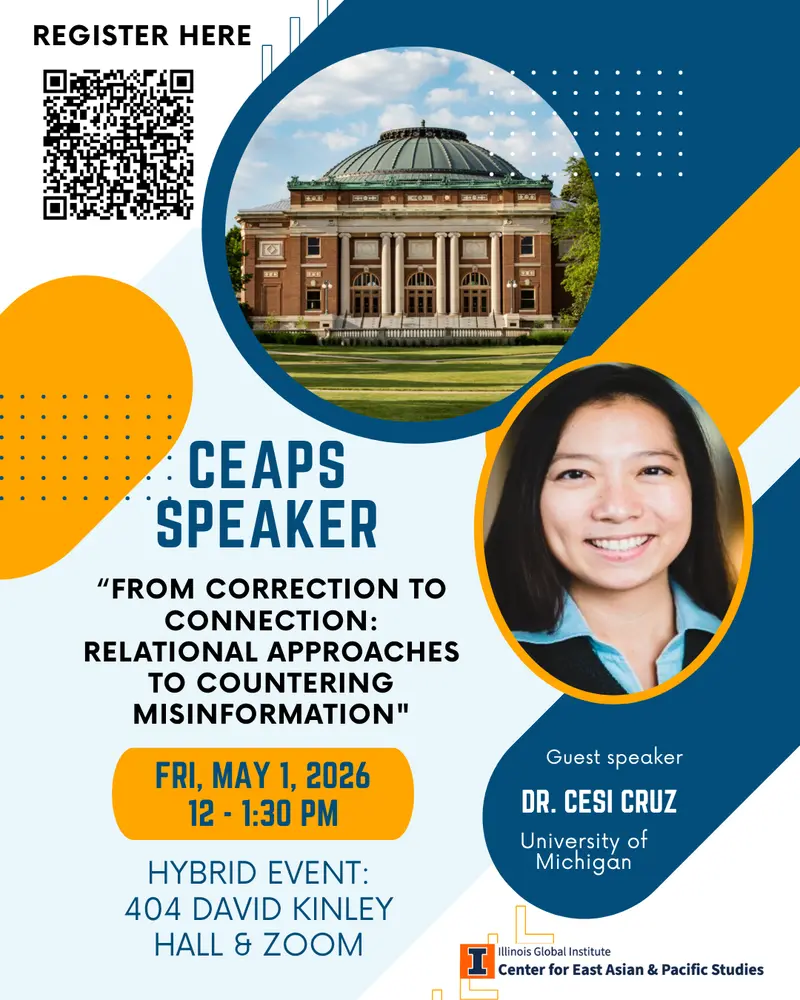
On Friday, May 1st, the Center for East Asian and Pacific Studies (CEAPS) will be welcoming Dr. Cesi Cruz, an Associate Professor of Economics and Political Science at the University of Michigan. Dr. Cruz received her Bachelor of Arts from McGill University and her PhD from the University of California in San Diego. She works on topics at the intersection of political science and economics, including elections, misinformation, gender and inclusive development.
Her research examines political accountability and governance, with a focus on how information, institutions, and social networks shape political behavior in developing democracies. She has traveled to Cambodia and the Philippines to complete fieldwork for her research. She incorporates social network analysis, surveys, and field experiments. Her work has been published in outlets such as the American Political Science Review, American Economic Review, American Journal of Political Science, Economic Journal, and Comparative Political Studies.
Cesi is a board member of Experiments in Governance and Politics (EGAP) and Women Also Know Stuff, an organization to promote women’s scholarship in political science. Cesi also serves on the editorial board of the American Political Science Review and VoxDev.
Dr. Cruz's upcoming talk with CEAPS will be titled "From Correction to Connection: Relational Approaches to Countering Misinformation" and will focus on the prevalence of misinformation in the age of social media. As social media becomes an important source of political information in many democracies, citizens are increasingly exposed to misleading content that distorts public discourse and weakens trust in institutions. Dr. Cruz's research took her to the Philippines where studied 160 villages to determine if relational information environments are responsible for the pervasiveness of misinformation on the internet. She chose the Philippines, because it is a country often cited as an early case of social media-driven democratic backsliding. Her team designed and implemented in-person workshops for voting-age adults combining media literacy training, role-playing exercises, and group discussions on information integrity. These sessions encouraged participants to assess content credibility, navigate disagreement, and reflect on the civic impact of sharing information. The results were astonishing.
Treated individuals perceived less political polarization and reported greater interest in politics. They relied less on Facebook, YouTube, and TikTok for political news and engaged more frequently in offline discussion through civic and religious networks. Comparable effects among untreated peers indicate meaningful community-level spillovers. Effects also extended to electoral outcomes: using official village-level electoral results, we find that, in treatment villages, candidates who relied heavily on Facebook advertising underperformed and voters were less responsive to false online rumors about local candidates.
Dr. Cruz will present her research at David Kinley Hall Room 404, 1407 W. Gregory Drive, Urbana. The talk will be on May 1st, 2026 from 12:00 - 1:30 pm. The Center for East Asian and Pacific Studies will be joined by the Department of Political Science as sponsors of Dr. Cesi Cruz's talk. Registration is now available for the event. You can register by visiting our Event Calendar and clicking on the Registration link under the event title.